

Sport infrastructure in KwaZulu-Natal is defined by a dual reality. On one hand, the province has adopted a structured, development-oriented infrastructure strategy supported by meaningful capital investment. On the other, widespread deterioration of key facilities, particularly in athletics, alongside weak maintenance systems and uneven implementation, is undermining both participation and high-performance outcomes. The result is a fragmented ecosystem where grassroots expansion is not translating into elite competitiveness or commercial viability.
1. Infrastructure Strategy and Development Model
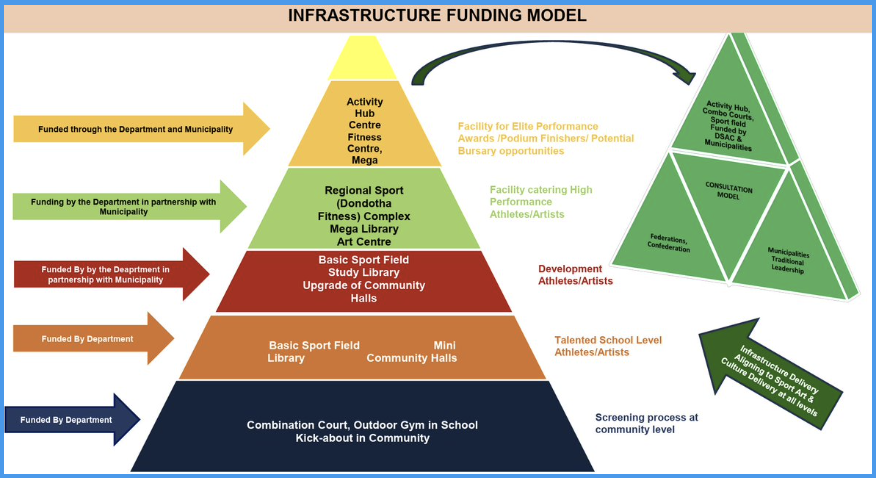
The KwaZulu-Natal Department of Sport, Arts and Culture has implemented a tiered infrastructure model that links community-level participation to elite performance pathways. Facilities range from basic assets such as combo courts, sport fields, and outdoor gyms to larger fitness centres and high-performance environments. This pipeline approach is aligned with talent identification programmes and initiatives such as the Isukile KZN ward-based model, which decentralises service delivery to communities and embeds sport at grassroots level
This strategic framework is conceptually strong and reflects global best practice. However, its effectiveness is constrained by the condition and usability of infrastructure, particularly at the upper end of the performance pathway.
2. Current Condition of Infrastructure
The most critical weakness in the province’s infrastructure landscape lies in athletics facilities. Several major stadiums, including Kings Park Athletics Track, Chatsworth Stadium, and Msunduzi Stadium, are currently unlicensed due to poor maintenance and deterioration. Regional facilities such as Ulundi and Richards Bay are similarly unable to meet international standards.
This decline has significant implications. KwaZulu-Natal is currently unable to host national championships or international qualifying events, which limits athlete exposure, reduces commercial opportunities, and contributes to talent migration to better-equipped provinces. Athletics has effectively become under-prioritised relative to other codes, despite its importance in the broader sports ecosystem.
3. Infrastructure Investment and Project Pipeline
The province initially allocated approximately R214 million to infrastructure for the 2025 to 2026 financial year, later adjusted to over R221 million. This funding supports new infrastructure, municipal transfers, leases, and limited maintenance.
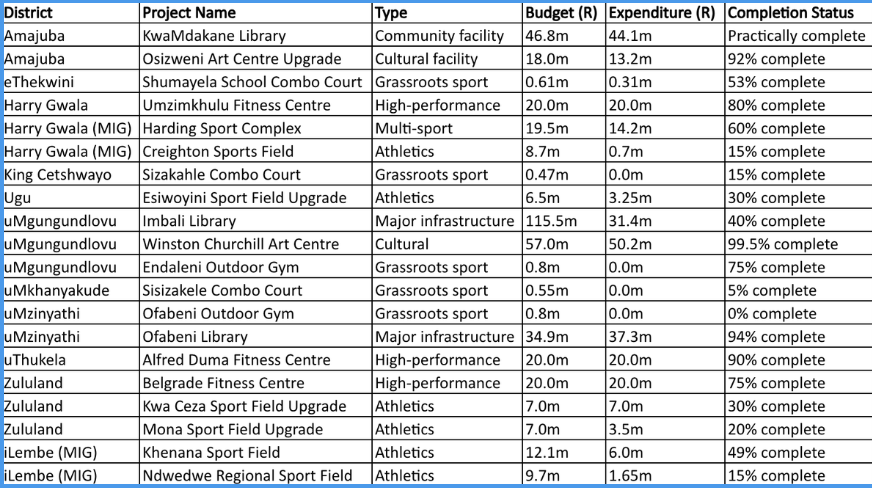
The data reveals a clear pattern. Larger capital projects such as fitness centres and cultural facilities are progressing well, often exceeding 75 percent completion. In contrast, grassroots and athletics-focused infrastructure projects are largely incomplete, with many below 50 percent completion and some still at procurement or early-stage implementation.
4. Budget Structure and Sustainability Constraints
The infrastructure budget is heavily weighted toward new construction rather than maintenance. Only a small portion of funding is allocated to repairs and rehabilitation, which contributes directly to the deterioration of existing facilities. Maintenance responsibility is largely devolved to municipalities, creating inconsistencies in execution and long-term asset management
Budget adjustments further highlight systemic inefficiencies. Funds have been reallocated away from delayed projects, while reductions in grassroots infrastructure spending reflect procurement challenges. This reinforces the broader issue of limited municipal capacity and weak project oversight.
5. Systemic Challenges
Several structural challenges continue to constrain infrastructure delivery and sustainability. These include the absence of dedicated maintenance funding, weak institutional capacity at municipal level, and disruptions during project implementation. Vandalism and poor workmanship further exacerbate the problem, with newly constructed facilities in some cases showing defects shortly after completion.
A critical strategic issue is the imbalance between participation infrastructure and competition-ready facilities. While the province is expanding access at grassroots level, it is simultaneously losing the ability to host elite athletics events due to non-compliant infrastructure.
6. Strategic Outlook and Conclusion
KwaZulu-Natal’s sport infrastructure strategy is built on a strong developmental foundation, with clear alignment between infrastructure investment, talent development, and social objectives. The introduction of ward-based delivery through Isukile KZN and the emphasis on monetisation in the 2025 to 2030 strategy signal a progressive shift toward sustainability and economic integration.
However, the current trajectory presents a risk. Without a decisive shift toward maintenance prioritisation, improved governance, and targeted investment in compliant high-performance facilities, the province will continue to expand participation without strengthening its competitive and commercial position.
The central challenge is not the absence of investment, but the effectiveness of its deployment.

Related Posts

Nominees Announced For The SPORTY LALIGA MVP
Discover the 2025/26 SPORTY LALIGA MVP, the fifth edition of the award…

Mixed 4Q 2025 Results for Betway (Super Group) In Africa
Africa now accounts for 42% of the group’s total net revenue (equating to…

CSA Appoints Shrey As Official Helmet and Luggage Partner
Cricket South Africa (CSA) has announced a new five-year partnership with…